No Mow May isn’t so straightforward. How do you parse out this puzzle and make the best management decision for wildlife and your lawn? Read to find out.
Amy Thomas, MSW, MNRD, GIP, Restoration Ecologist, President Wild Ones Midcoast Maine Owner of Keystone Native Habitat
Revised April 30, 2026
No Mow May started in 2019 by well-meaning citizen scientists in the United Kingdom calling for homeowners to hold off on mowing for the month of May to allow grasses and flowers, such as dandelions (not US natives), violets, etc., to provide food and shelter for pollinators.
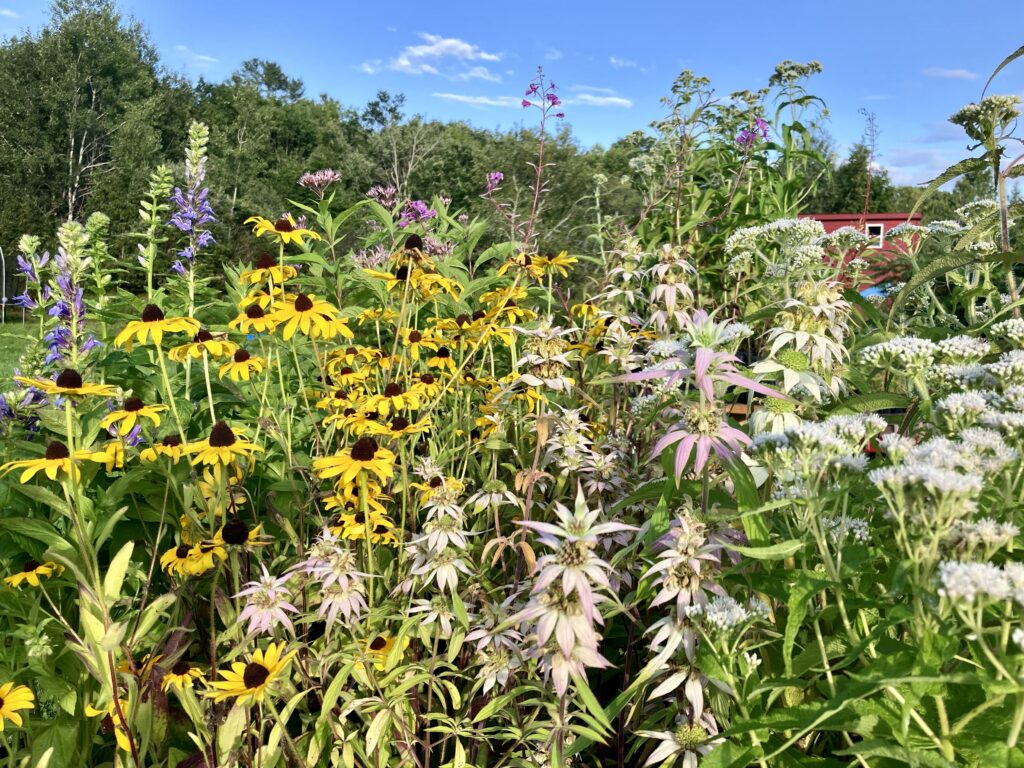
It made its way to Appleton, Wisconsin in 2020 and has since spread across the United States. I inherited a small, short, mixed-grass “flowering lawn” in my back yard. It’s where my dog fetches balls, and I spread a blanket in the sun – I love this area. A little patch of grass for kids or pets should not lead to guilt, but we’ve come to realize that sprawling monoculture exotic grass lawns, totaling some 40,000 acres or more in the United States, offer little ecological value.
So, how do we make lawns better? As it turns out, to mow or not, is more complicated than arbitrarily choosing to stop mowing your lawn from May 1 to May 31, or any other arbitrary 4-week window. It’s a catchy trend that leads you to believe you’re doing something good for the environment when there might be better options. But it depends. According to the Xerces Society, “There is no one-size-fits-all approach to No Mow May and it must be adapted to local conditions—weather, vegetation, and people.” So, how do you parse out this puzzle and make the best management decision for wildlife and your lawn?
In a world of unprecedented human-driven species decline, it might involve completely rethinking your lawn. “No Mow May on its own is not enough.” (Xerces 2025). What you want to do is assess the insect / wildlife value of your current lawn species, together with your management practices. There is an opportunity to make some impactful changes by controlling the composition of our yards and lawns. We can shrink our lawn and never have to worry about mowing again, which makes good environmental sense (Lerman 2019). And we can diversify the plant species within our remaining lawn to benefit insects and wildlife, adopting scientifically supported management strategies for our particular patch. Think of the process of determining what’s best for your lawn as a bit of an “if, then” equation.
Shrink Your Lawn
This is the best thing you can do with a lawn for wildlife. If you find you can reduce the size of your lawn, transition that area to valuable insect / wildlife habitat using native species. There are numerous techniques to convert lawns to wildlife habitat. You can plant a “flowering lawn,” create a meadow, add native shrubs, small trees, a micro-forest, or even opt for complete reforestation. For the purposes of this article, we’ll mostly be diving into “flowering lawns,” touching a bit on “lawn meadows,” and exploring best practice mowing cycles. Determining if you want to A) stay short, or B) go tall, will determine the steps of your transition.
Species Composition
Once you figure out what will remain as “lawn,” then figure out whether changing your mowing schedule is beneficial, and if so, at what interval? To determine this, figure out the species composition of your remaining lawn. There are apps and field guides to help you do this. You don’t need exact percentages, but get a rough percentage of grass, to native wildflowers, to non-native weedy species.
Grass Only
If you have a “weed-free” exotic, grass-only, monoculture and you choose to keep it this way, then from a wildlife perspective, it does not benefit wildlife to stop mowing, and letting the grass grow long can strain your mower and result in brown, burned areas when you finally do mow. The suggested management for a “weed-free” exotic species, grass lawn is to continue regular mowing, possibly investing in a push or electric mower to reduce environmental impact.
Over-seeding or Interplanting into Grass Only
If you have grass-only and want to increase the diversity, and prefer a shorter stature, then incorporate herbaceous forbs (wildflowers) to increase insect / wildlife value. Try “over-seeding” with a variety of shorter species – violets, self-heal, or bluets, pussytoes, blue-eyed grass (an orchid), trout lily, yarrow, wild strawberry, and moss phlox, depending on your aesthetic and conditions. Wild Seed Project is a great source for native seeds. Follow planting instructions, scratch seeds in for “soil seed contact,” at the right time of the year – often fall for wildflowers. You can “scalp” away grass in small openings with a hoe to reveal bare mineral soil, shallowly seeding into small patches, sprinkling with a little sand. You can also interplant plugs or larger nursery plants of these shorter species into your lawn. Wild Ones Midcoast Maine has list of native plant nurseries as well as a large native plant sale in Camden every year specializing in safely grown native plants, as do several other organizations throughout the year. Once you have created a high-quality native flower component of short species, then this lawn is probably a good candidate for 2-week mowing intervals. (More on this below).
Herbaceous Mix
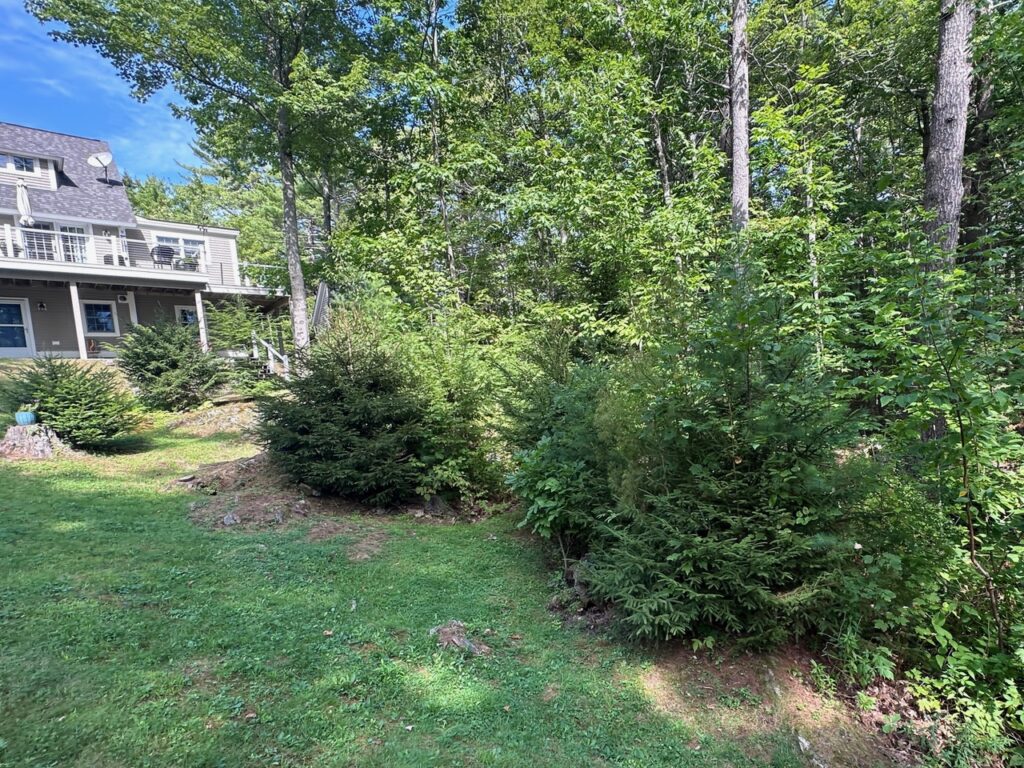
What if you already have a mix of plants besides grass in your lawn, and prefer a shorter lawn? You again want a decent idea of your composition percentages – percent grass to herbaceous forbs (wildflowers), to weedy exotics.
This information will be used to take different recommended “if, then” directions. If you have a high native flower component of short species, then this lawn is a good candidate for 2-week mowing intervals. (More on this below). But what if you have lots of exotic noxious weeds with only a few native flowering species? This lawn could still be a good candidate for a 2-week mowing interval, but it would not be good candidate for a mowing schedule which lets these species go to seed.
Do you remember the recent “rewilding” craze, also from the UK, where any plant that was growing in a lawn or flower bed, garden etc., no matter native or weedy exotic, were left to grow and go to seed? This will encourage a real headache of future weed management. If you have areas which are heavily invaded, your better options are to mow regularly, possibly mow every 2 weeks, and maybe even consider starting over if it’s a manageable sized area, creating a native “wildflower lawn.” Stick with seeds from Wild Seed Project or other reputable seed sources who sell Maine appropriate natives. Even better, sustainably collect your own native seeds, saving money and increasing valuable local ecotypes, and achieving the highest wildlife value. Using low-grade commercially available mixes will result in poor finished quality that may need to be re-done.
More of a “Meadow Lawn”
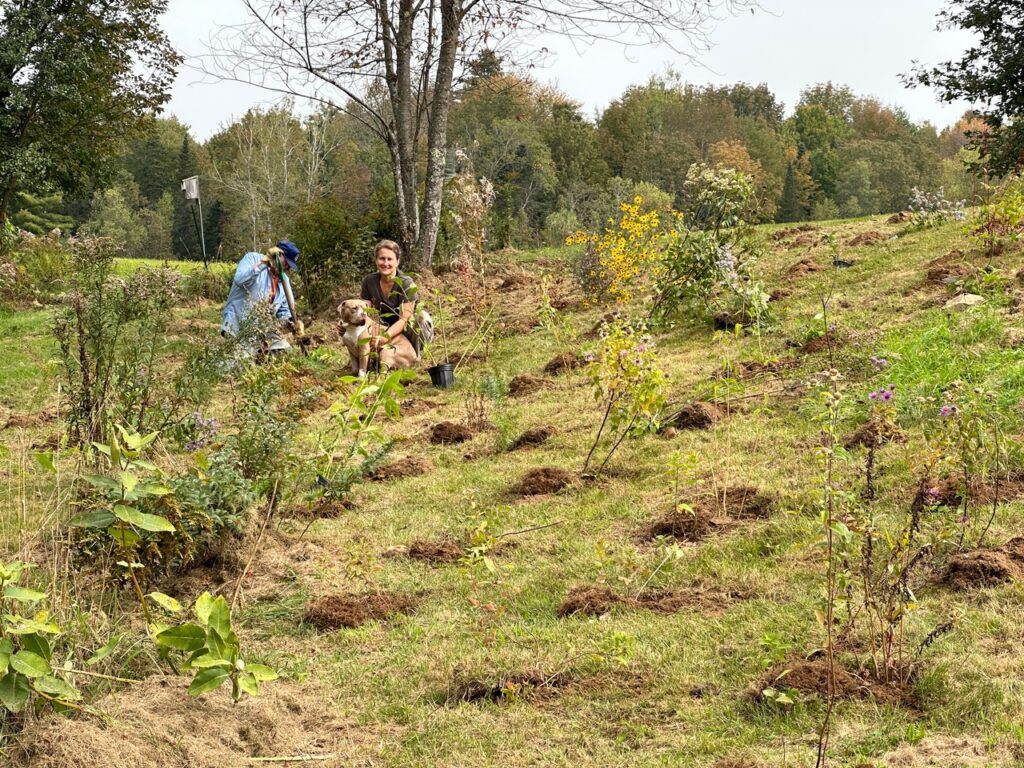
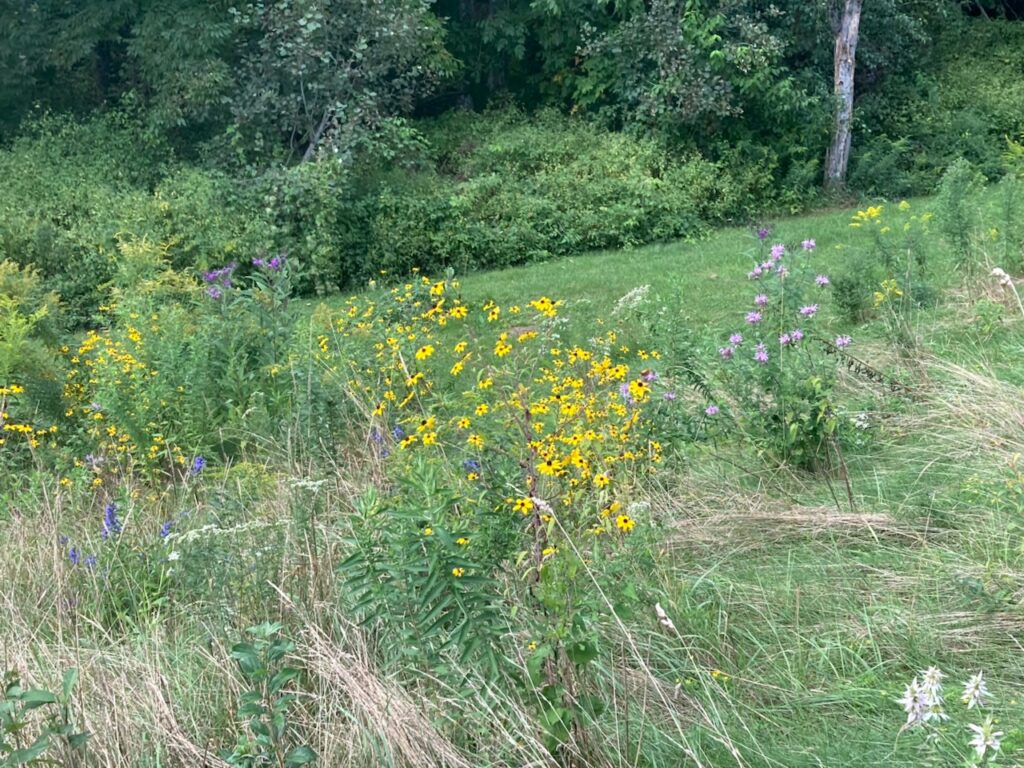
If you have tall native flowers growing in your lawn or would like to create a tall “meadow lawn,” you can plant taller native herbaceous perennials directly into a grass lawn as Tracy Weber, former owner of Blue Aster Native Plants, did at her nursery location in South China. This option can reduce mowing entirely or reduce mowing to once or twice a year. Just for reference a more “true meadow” akin to a midwestern prairie, would ideally be devoid of exotic grasses, and would employ different management practices all together. Also, “meadow lawns” may need to be shred, or “bush-hogged,” rather than mowed with a lawn mower, even at its highest setting.
The Sweet Spot for Bees – A 2-week Mowing Cycle
In possibly the first study of its kind, researchers mowed participant’s urban lawns at 1, 2 and 3-week intervals. They discovered the 2-week mowing cycle increased the number of “available” flowers in grass lawns, which corresponded to an increase in native bee occurrence (Lerman 2019). Researchers on Lerman’s team discovered that native bee species were less able to utilize flowers once the grass grew above flower height – which occurred after the 2-week mark, by week three. They did not research lawns left un-mowed for 4 weeks, but flowers in an un-mown lawn probably won’t become more accessible at 4 weeks. A 2-week mowing interval may also benefit pollinators besides bees, especially small flying pollinating insects such as wasps, flies, moths, beetles, butterflies, etc.
Putting Off Mowing Until after Flowers Go to Seed?
I recently heard a professional suggest it is best to let a lawn with flowers go un-mowed until the flowers go to seed, which in most cases would be well past the 4-week mark. This would be 100 percent true in true meadows, prairies, and in many garden settings. However, I am reluctant to advise this for a “flowering lawn” unless you have very tall species of native wildflowers, and you are going for more of a “Meadow lawn.” If you have exotic grasses in the mix, and normally have a short lawn, there are practical and aesthetic considerations. Neighbors often have their limits and may start to feel uncomfortable with a “messy” yard, and again, long grass can be hard on your mower and long lapses in mowing may, if the grass composition is high, cause brown patches – and keep in mind, after 2 weeks the grass often grows taller than shorter wildflowers making nectar and pollen inaccessible to pollinators.
As you can see, No Mow May might be more of mowing every 2 Weeks, but it depends – it can be complicated, and not one size fits all. With a little detective work and applying some of the suggested guidelines, you can figure out the most ecologically sound mowing schedule. And, over time, you may even decide to shrink your lawn, increasing wildlife benefit even further.
References
Lerman SB, Contosta AR. 2019. Lawn mowing frequency and its effects on biogenic and anthropogenic carbon dioxide emissions. Landscape and Urban Planning 182: 114–123.
Lerman, SB, Larson KL, Desirée L Narango, Mark A Goddard, Peter P Marra, Humanity for Habitat: Residential Yards as an Opportunity for Biodiversity Conservation, BioScience, Volume 73, Issue 9, September 2023, Pages 671–689, https://doi.org/10.1093/biosci/biad085
Lerman SB, Milam J. 2016. Bee fauna and floral abundance within lawn-dominated suburban yards in Springfield, MA. Annals of the Entomological Society of America 109: 713–723.
Shepherd, M, Rost, L. No Mow May: An Easy Start for a Nature Friendly Yard. (But Not the Finish Line). 2025. Xerces Society Blog https://www.xerces.org/blog/no-mow-may-easy-start-for-nature-friendly-yard-but-not-finish line#:~:text=No%20Mow%20May%20began%20in,a%20Bee%20Campus%20USA%20affiliate
Shepherd, M. No Mow May: A Starting Point, Not the Finish Line. 2024. Xerces Society Bug Banter Podcast https://www.xerces.org/bug-banter/no-mow-may-starting-point-not-finish-line